A Rainy Afternoon Built Around One Local Question
Plan a rainy afternoon around one local question: use a covered public place to follow it, meet everyday life, and make a wet travel day feel connected.
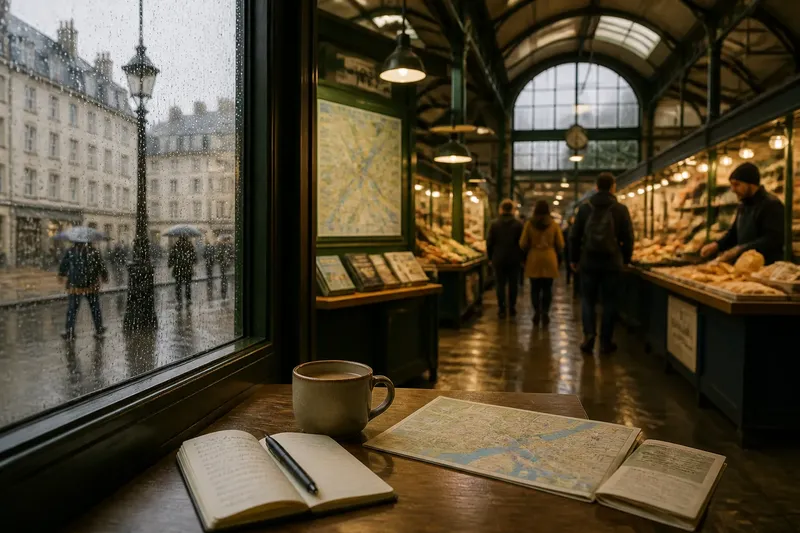
Rain taps the windows of the café, the square has emptied, and your afternoon plans no longer fit the weather. A rainy afternoon in a new place can still feel connected to the town if you choose one local question and follow it through a covered public setting. Instead of collecting indoor attractions, use the question to guide what you notice, who you can ask, and when to move on.
1. Choose a question with local roots
A useful question is specific enough to guide an afternoon but open enough to lead somewhere unexpected. Ask about a visible feature of everyday life: Why does this neighborhood have so many small bakeries? Where does the town’s drinking water come from? What makes this harbor important to people who live here now?
Keep the question about the place, not just about a building or a famous name. “What is this museum about?” can usually be answered by reading its entrance sign. “How did this river shape the work and routines of people nearby?” can connect a museum display with the streets, shops, and public conversations around it.
Before setting out, write the question in your phone or on a scrap of paper. Add one sentence about why it caught your attention. That small note helps you recognize useful details later, rather than treating every indoor stop as a separate activity.
2. Pick a covered public setting
Look for a place where people have a reason to gather or pass through, not simply a roof to wait under. A public library, covered market, ferry terminal, neighborhood cultural center, historic arcade, or indoor food hall can offer shelter and clues to local routines. The best choice depends on your question: a transport hub may help with a question about movement, while a library can be useful for local maps, neighborhood histories, or community notices.
Check opening hours, access rules, and whether the space is intended for quiet use before you go. A library is for reading and borrowing, not an excuse to interrupt visitors. A market is a place where vendors are working; browse considerately and buy something if you choose to linger. Follow posted rules and ask staff before taking photographs.
Think of the setting as a window with a roof: it protects you from the rain while giving you a view of how the place works. It does not need to be an official attraction. A public lobby or arcade may be more revealing than a ticketed venue if local people use it as part of an ordinary day.
3. Follow the question inside
Once you arrive, look for evidence that speaks directly to your question. At a covered market, notice what is sold, what comes from nearby, and which stalls serve shoppers who appear to be on a routine errand. In a library, check local-history displays, community calendars, maps, or a local newspaper. In a ferry terminal, watch how signs, waiting areas, and route information organize movement.
Read labels and notices before reaching for your phone. A place’s vocabulary can matter: a name on an old map may still appear on a route board, or a community notice may describe a gathering that explains why a particular building stays busy. Separate what you can see from what you infer. A crowded counter tells you that people are there; it does not, by itself, explain why.
Gather a few different kinds of clues rather than chasing every interesting detail. A sign, a map, an object, and a brief conversation can offer more useful angles than a long list of unrelated facts. If a clue does not connect to your question, make a note and let it go.
4. Ask without turning people into guides
A short, respectful question can add context that a display cannot. Ask a librarian where to find local maps, a market vendor what an unfamiliar food is called, or a terminal staff member where the public route information is posted. Keep your request easy to answer, and accept a brief reply without pressing for a personal story.
If someone seems busy, distracted, or uninterested, move on. Do not treat a worker as an informal tour guide, and avoid asking strangers to speak for an entire community. A question such as “Is there a local word for this?” invites a small, specific answer; “What do people here think about everything changing?” asks for far more than a brief encounter can fairly provide.
Record the information in your own words, and note where you heard it. If a person gives you a suggestion for a book, display, or public notice, follow up there rather than relying on memory alone. This keeps the afternoon focused while giving the person room to return to their day.
5. Let one clue lead onward
Choose one clue that genuinely changes or sharpens your question, then follow it to a nearby covered place if appropriate. A market sign might point toward a local food tradition; a map in a library might show how a neighborhood connects to the waterfront; a route board may reveal which districts people travel between. One clear link gives the afternoon a thread without turning it into a race across town.
Say you are in an unfamiliar port city and wonder how the harbor fits into daily life. At a covered terminal, you notice a public route map showing connections to residential neighborhoods, then ask staff where to find a map intended for passengers. You might follow the information to a nearby public library or indoor waiting area and compare what the routes suggest with the notices and businesses around you. The expected result is not a definitive history of the harbor, but a more grounded question about how people use it now.
Keep the next stop practical. If it requires a long walk in heavy rain, a private venue, or a hurried conversation, it may not be worth following. The question is there to help you choose, not to make every clue into an obligation.
6. Leave room for the weather
Set a loose boundary for the afternoon before you start: perhaps one main covered setting, one nearby follow-up, and time to sit down. That is a shape, not a schedule. Rain can slow transport, change opening hours, or make a short walk uncomfortable, so leave the route easy to adjust.
Carry a compact umbrella or rain shell, keep notes somewhere they will stay dry, and check local transit information before moving to another district. If the rain becomes unpleasant or conditions make travel difficult, stay in one public place or head back to your accommodation. A good plan has a sensible stopping point.
Give yourself permission to spend longer with a useful clue and less time with a dull one. The purpose is not to fill every moment; it is to let one question make the shelter feel like part of the journey rather than a pause from it.
7. Keep a question, not a verdict
Before leaving, write down one thing you observed, one thing you learned, and one uncertainty that remains. Keep the distinction clear: a notice may establish where an event takes place, while a conversation may offer one person’s view of why it matters. A careful note preserves both without turning an impression into a claim about everyone who lives there.
If a display, map, or local publication gives you a lead, note its name so you can look for it later. You do not need to gather a souvenir or turn every detail into a polished story. A clear record of the question and the clue that changed it may be enough to make the afternoon memorable.
Questions for rainy travel days?
What makes a good local question?
Choose something connected to visible routines, a local feature, or a place’s shared spaces. Keep it open enough to explore, but specific enough to help you decide what to notice.
Where can I go when it rains?
Consider a public library, covered market, indoor food hall, ferry terminal, cultural center, or arcade. Choose a place that suits your question and welcomes visitors for the purpose you have in mind.
How do I learn without bothering people?
Start with public signs, maps, displays, and notices, then ask staff a brief question only when it fits their role. Respect a short answer, a refusal, or a busy moment.
What if the clue leads nowhere?
Return to your original question and choose another source in the same setting. If nothing useful emerges, write down what you did observe and let the afternoon end without forcing a conclusion.
A rainy afternoon built around one local question works best when the question remains small enough to carry with you. Keep it in your notes, alongside the place where it began and the clue that altered it. You may leave without a complete answer, but with a sharper sense of what to look for when the weather clears.