How Postcards Became Travel Keepsakes
Learn how postcards became travel keepsakes, and read their images, messages, and postal marks as a personal record of a journey and its era.
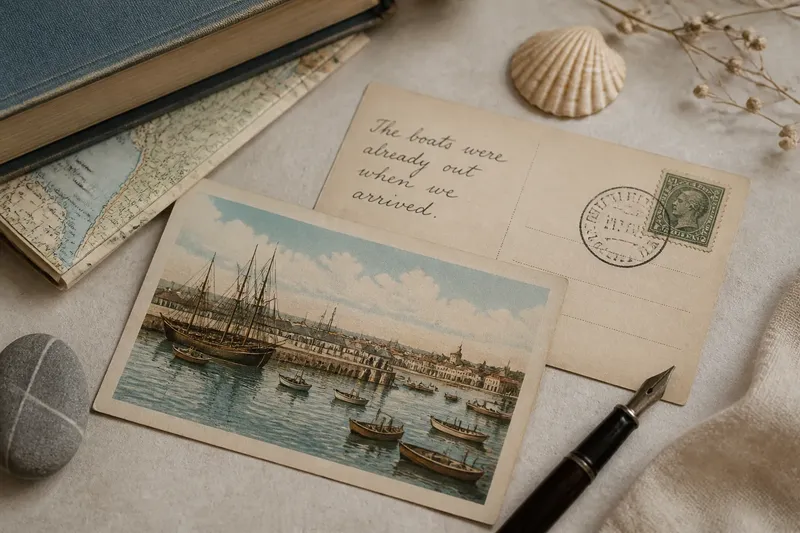
You find an old postcard tucked inside a guidebook: a harbor on the front, a few lines in familiar handwriting on the back. Postcards became travel keepsakes as travelers and recipients began treating these brief messages as objects worth saving, not just mail to read and discard.
There was no single moment when that change happened. The shift was gradual, and it varied by card, sender, and recipient. A plain message card could be saved, while an illustrated one could be thrown away; the format made both uses possible.
From message to image
A postcard offered a compact way to send a short message. Its open format suited a quick greeting, and an image, when present, could identify a destination before the recipient read the note.
Travel cards were not always the illustrated souvenirs familiar today. Plain cards carried correspondence without a picture. As illustrated cards circulated, travelers could choose a local view alongside a simple message, combining a greeting with a portable depiction of a place.
That pairing did not make every card a keepsake. It did, however, give a recipient two things to revisit: the sender’s words and the selected image. The card might call to mind a landmark, a street, or a private reference that mattered only to the people exchanging it.
Why travelers saved postcards
A card could outlast its original news because it held more than information. A handwritten name, a postmark, an address, or a remark about the trip could connect the printed view to a particular person and moment.
Travelers also chose what to represent. One sender might select a recognizable landmark so a relative could place the destination; another might prefer a harbor, shopfront, or everyday street that matched a personal impression. The image was a selection, not a complete account of the trip.
Imagine a traveler in a coastal town with a card showing its busy harbor. They write that the morning boats made the place feel lively and mail it to a cousin. The cousin might keep the card for the harbor view, the note, or both; the result is a small record linking a chosen scene to the traveler’s first impression.
Reading postcard evidence
An old postcard is useful to read as an object with several parts, rather than as a transparent picture of the past. The printed view shows what a publisher offered, while the message reflects what one sender chose to tell a particular recipient.
- Check whether the picture shows a landmark or an ordinary street; if it emphasizes a famous sight, treat it as a selected view, and if it shows daily activity, look for details that the image makes visible.
- Check the message against the picture; if the words describe the scene, read them together, and if they mention something outside the frame, note that the image leaves part of the trip unshown.
- Check the handwriting and sign-off; if they suggest a personal exchange, consider the relationship as part of the card’s meaning, and if they offer little context, avoid guessing who the recipient was to the sender.
- Check the address and postmark; if they are legible, use them as clues to where the card was sent and handled, and if they are unclear or absent, leave that part of its route uncertain.
- Check the publisher’s caption or printed label; if it names a specific place, compare that claim with visible landmarks, and if it is vague, describe the view without assigning it a precise location.
- Check what the image leaves outside its frame; if it focuses on a polished attraction, treat it as a particular portrayal, and if it includes less staged details, describe only what can actually be seen.
Say you have a card labeled with a coastal town, showing a pier and carrying the note, “The boats were already out when we arrived.” The postmark is blurred, so you can identify the town from the label but not the exact mailing point. Read the pier as the selected image and the sentence as the sender’s observation; do not infer the arrival date or claim the view represents the whole town.
Postcard history questions?
Were postcards originally souvenirs?
Not all postcards began as souvenirs: plain cards could carry brief correspondence without an illustrated view. A card’s later meaning depended in part on whether someone chose to keep it.
Why were postcard messages brief?
The card provided limited room for writing, and a picture could identify the place without a long description. A sender could use the note for a greeting or one detail of the trip.
What makes a postcard a historical record?
A card may preserve an image, handwriting, an address, and postal marks together. These offer clues about a chosen portrayal and an individual exchange, but they do not by themselves establish a complete account of a place or journey.
Did postcards replace travel letters?
No single format had to replace the other. A postcard suited a short, visual greeting, while a letter could accommodate a longer account; a traveler could choose according to the message they wanted to send.
Keeping the whole card
A postcard’s value as a travel keepsake comes from the combination of public image and personal message. Like a ticket tucked into a book, it can begin as something functional and later prompt memories beyond its original purpose.
When you handle an old card, read both sides before deciding what it records. The image shows the place as someone chose to present it; the handwriting and postal marks may connect that view to a sender, a recipient, and a journey, while any missing details should remain uncertain.